
Comparison
The Leitner System for German: Spaced Repetition with a Box of Cards
Five compartments, one rule, no screen. How to set up a Leitner box for German vocabulary, what to write on the cards, and when paper stops being enough.
Last updated
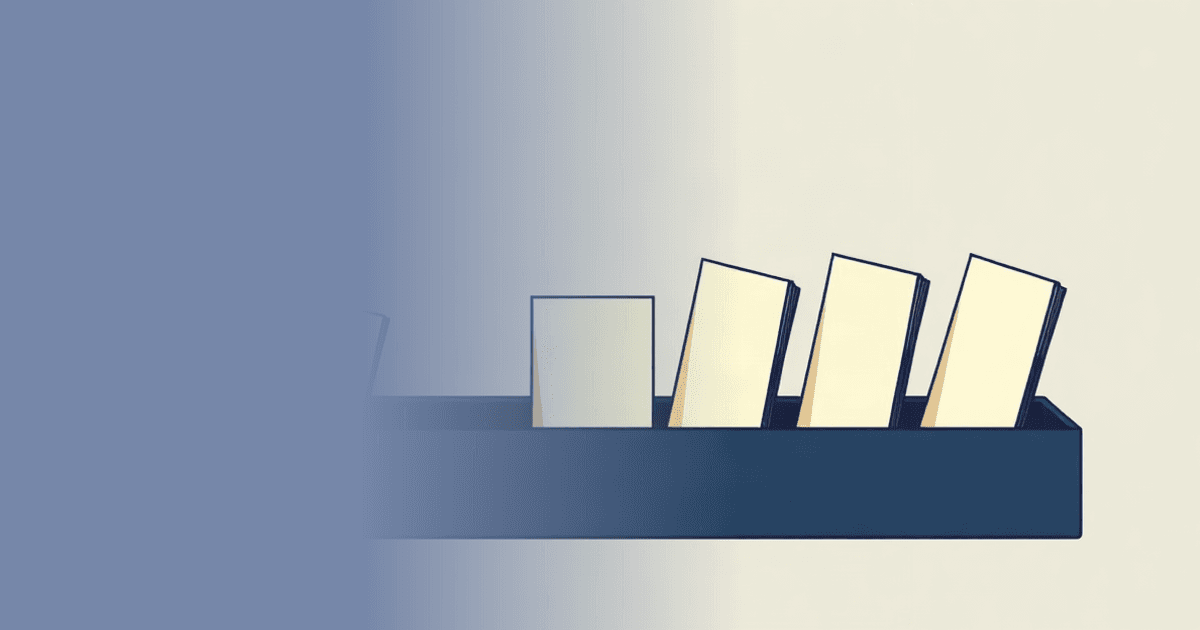
Spaced repetition as an everyday tool began in the German-speaking world, with a cardboard box. In 1972 the journalist Sebastian Leitner published So lernt man lernen ("How to learn to learn"), and in it a simple device: a card file with compartments of growing size. German schoolchildren have used the Lernkartei or Karteikasten ever since, and you can still buy one in any German stationery shop for a few euros.
Every flashcard app is a descendant of that box. If you like paper, want time away from a screen, or want to understand what your app is doing, building one is worth an afternoon. It works, with limits that are worth knowing in advance.
How the box works
You need a long box with five compartments and a stack of index cards. One side of each card has the question, the other the answer.
- Every new card starts in compartment 1.
- If you know a card, it moves one compartment forward.
- If you do not know it, it goes back to compartment 1.
Each compartment is reviewed less often than the one before. That is the whole system. Cards you know travel to the back and are seen rarely; cards you keep missing stay at the front and are seen daily.
A schedule for the five compartments
Leitner's original box had no calendar. The compartments grew in size, and you reviewed one when it was full. That is elegant and a little vague. Most people today use fixed days.
| Compartment | Review | A card that is always right reaches it after |
|---|---|---|
| 1 | Every day | Day 0 |
| 2 | Every 2 days | Day 1 |
| 3 | Once a week | About day 3 |
| 4 | Every 2 weeks | About day 10 |
| 5 | Once a month | About day 24 |
| Out of the box | Finished | About day 54 |
A practical way to run it: compartment 1 daily; compartment 2 on Monday, Wednesday, Friday and Sunday; compartment 3 every Saturday; compartment 4 on the first and third Sunday of the month; compartment 5 on the first Sunday. Write that on the inside of the lid.
For long-term learning, add a sixth and seventh compartment for three and six months. Without them, a word leaves the box after about two months, which is too early for it to be permanent.
What to write on a German card
Paper tempts you to write too little. Take the extra ten seconds.
Nouns. Front: table. Back: der Tisch, die Tische and one short sentence, Das Buch liegt auf dem Tisch. Always the , always the . Many German pupils write the in a colour: blue for der, red for die, green for das. On paper this is easy and it helps.
Verbs. Front: to help (+ case?). Back: helfen, hilft, half, hat geholfen + Dativ and Kannst du mir helfen?
Phrases. Front: to make a decision. Back: eine Entscheidung treffen.
Three rules:
- English on the front. Producing the German is the harder and more useful direction. If you only need to read, turn the box around.
- One answer per card. A word with three meanings gets three cards.
- Say the answer aloud before you turn the card. Thinking "I know that one" is not the same as producing it.
The full template by word type is in how to make German flashcards.
A daily routine
1. Review what is due, starting with the highest compartment due today and ending with compartment 1. Old cards first, while you are fresh. 2. Add new cards to compartment 1: five to ten a day. 3. Go through compartment 1 again at the end, until every card in it has been right once. Those then move to compartment 2 tomorrow.
Ten new cards a day fill a box quickly. After two months you have 600 cards; a standard A7 file holds about 1,000. Why ten is a sensible is in how many German words per day.
What paper is good at
- Writing is learning. Writing
die Voraussetzungby hand, with its and a sentence, is already a first repetition, and a slower, deeper one than tapping "add". - No screen. No notifications, no battery, no other app one swipe away. For many people this is the entire reason, and it is a good one.
- You see your progress. The front compartment thins out and the back ones fill up. A box with 400 cards in compartment 5 is a satisfying .
- It is flexible. Draw on the card, add a mnemonic, stick in a picture.
- It costs five euros.
Where paper reaches its limits
"Back to the start" is harsh. A word you knew for a month and missed once goes all the way back to compartment 1 and needs five correct answers to return. Many digital systems drop it one or two steps instead. If the full reset frustrates you, adopt that as a house rule: a missed card moves back two compartments, not all the way.
No audio. The box cannot tell you that Büro is stressed on the second syllable. Check every new word once in a dictionary with recordings, and mark the stress on the card. More in German flashcards with audio.
It does not scale. A thousand cards is a full box. German to B1 is 2,400 words, to B2 about 4,500. That is five boxes, and finding out which compartments are due across five boxes becomes its own task.
It does not travel. Ten minutes on the train is where most people's reviews happen.
The schedule is coarse. Compartments are reviewed as a whole, so a card added yesterday and a card added three weeks ago are treated alike. Software tracks every card separately.
Card making takes time. Two minutes per good card, so the B1 list is 80 hours of writing. For your own words, that time is learning. For the standard 2,000 words everyone needs, it is copying a dictionary.
Who should use a box
- Beginners in the first months. A few hundred cards, written by hand, is an excellent start and teaches you how the method feels.
- Children and teenagers learning German at school, where a physical box on the desk works better than an app on a phone.
- People with a screen-free rule in the evening.
- Anyone with a small, personal set: the fifty phrases you need at work, the vocabulary of one hobby.
- As a second system next to an app, for the stubborn words. Writing a word by hand that has failed five times on a screen often breaks the pattern.
From the box to software
If the box works for you and you outgrow it, the step to software is small, because the logic is the same. Every spaced repetition app is a Leitner box with more compartments and a calendar that tracks each card.
The fixed-ladder systems are the closest relatives. merke.me, for example, is recognisably a Leitner box with eight compartments: 4 hours, 8 hours, 1 day, 2 days, 1 week, 2 weeks, 1 month, 4 months. A correct answer moves an entry forward one compartment. A wrong one moves it back one or two, not to the start. After the eighth, the entry is out of the box for good. The difference is what the box cannot do: the cards are already written, with , , example sentences and audio; grammar points sit in the same box as words; and the calendar is kept for you. How fixed ladders compare with algorithmic schedules is in spaced repetition schedules explained.
Many learners keep both. The box holds the fifty words that are theirs alone, written by hand. The app holds the 5,000 that everyone needs. If you want to see the digital half, the decks are ordered from A1 to C2, the vocabulary is open to read, and the first 100 words and 30 grammar points are free.
And if you stay with paper: buy the box, write ten cards tonight, and review compartment 1 tomorrow morning. That is the method. Leitner would recognise it.
Look these up
Keep reading
Try it yourself
merke.me is a complete A1-C2 German course on a spaced-repetition schedule: vocabulary, grammar and expressions, with native audio and example sentences.
Start free